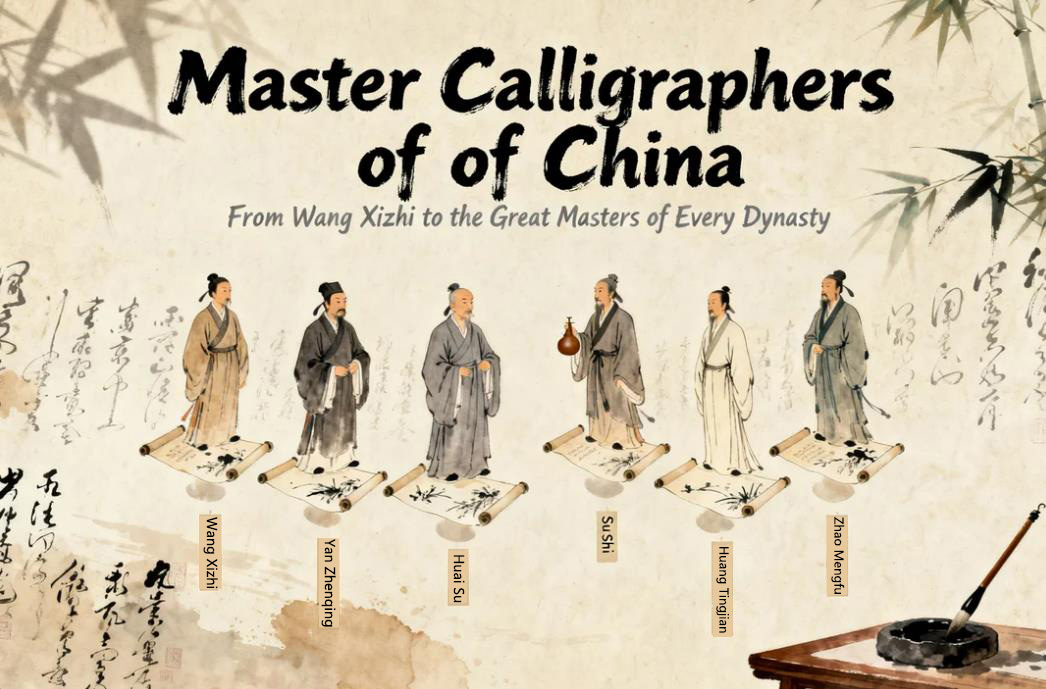
Chinese calligraphy has produced many legendary artists over more than two thousand years. Some are admired for their technical perfection, others for their emotional power, and still others for breaking conventions and creating entirely new styles.
This guide introduces six of the most influential calligraphers in Chinese history, their representative works, and what makes each of them distinctive.
Wang Xizhi: The Sage of Calligraphy
Wang Xizhi (303–361) is widely regarded as the greatest calligrapher in Chinese history. He lived during the Eastern Jin dynasty and was especially celebrated for his running script.
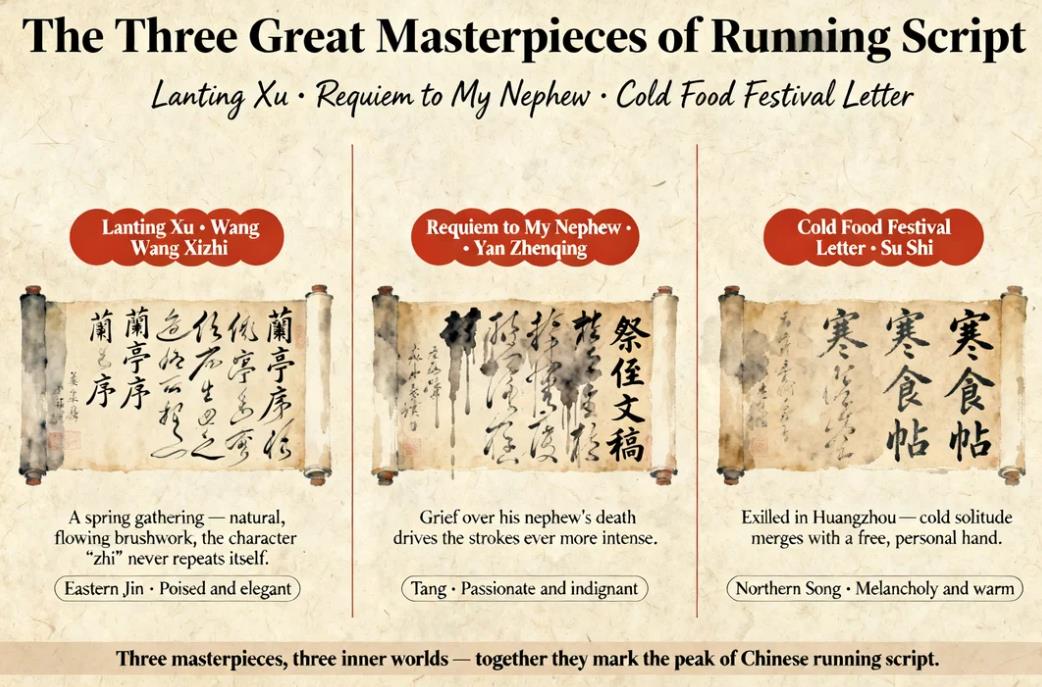
His most famous work is the Preface to the Poems Collected from the Orchid Pavilion, also known as Lanting Xu. According to tradition, Wang Xizhi wrote it during a spring gathering at the Orchid Pavilion, after drinking wine and composing poetry with friends. The text reflects on life, time, and mortality, while the brushwork flows with remarkable naturalness.
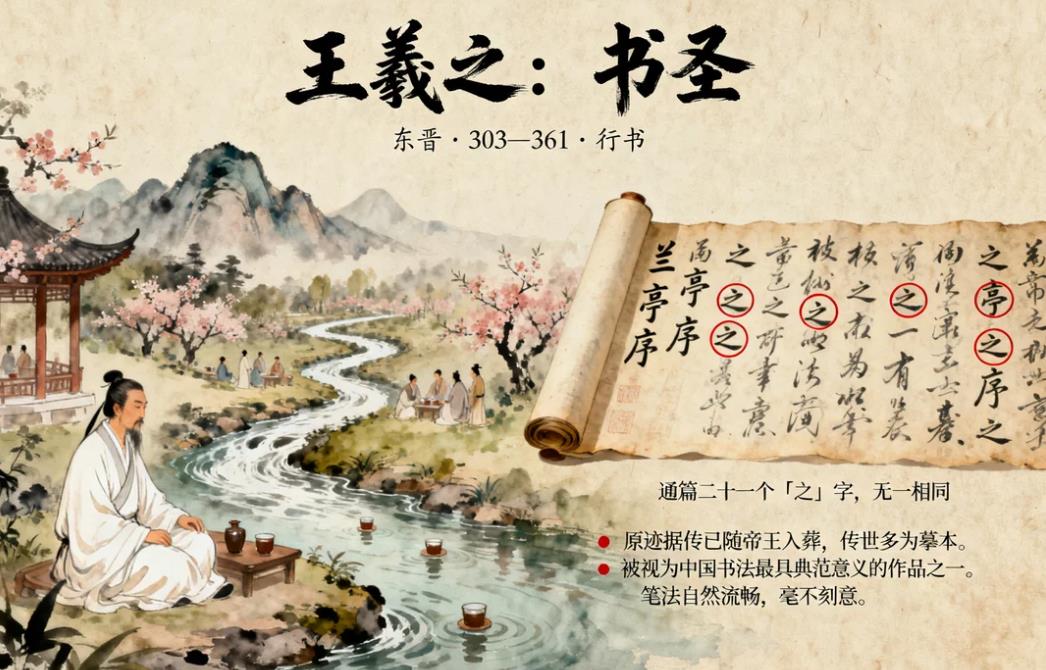
What makes Lanting Xu so admired is its variation. The character for “zhi,” meaning “of” or “it,” appears many times in the piece, yet each instance is written differently. This shows Wang Xizhi’s extraordinary control and spontaneity.
The original manuscript is believed to have been buried with an emperor, so only later copies survive. Even so, it has remained the most celebrated model in Chinese calligraphy.
Yan Zhenqing: Strength and Dignity in Regular Script
Yan Zhenqing (709–785) lived during the Tang dynasty and is one of the most important figures in regular script. His style is broad, heavy, and upright, giving his characters a sense of moral strength.
Yan Zhenqing was not only an artist but also a loyal official. He served the Tang court during a period of rebellion and ultimately died for his loyalty. Because of this, later generations often read his calligraphy as an expression of integrity and courage.
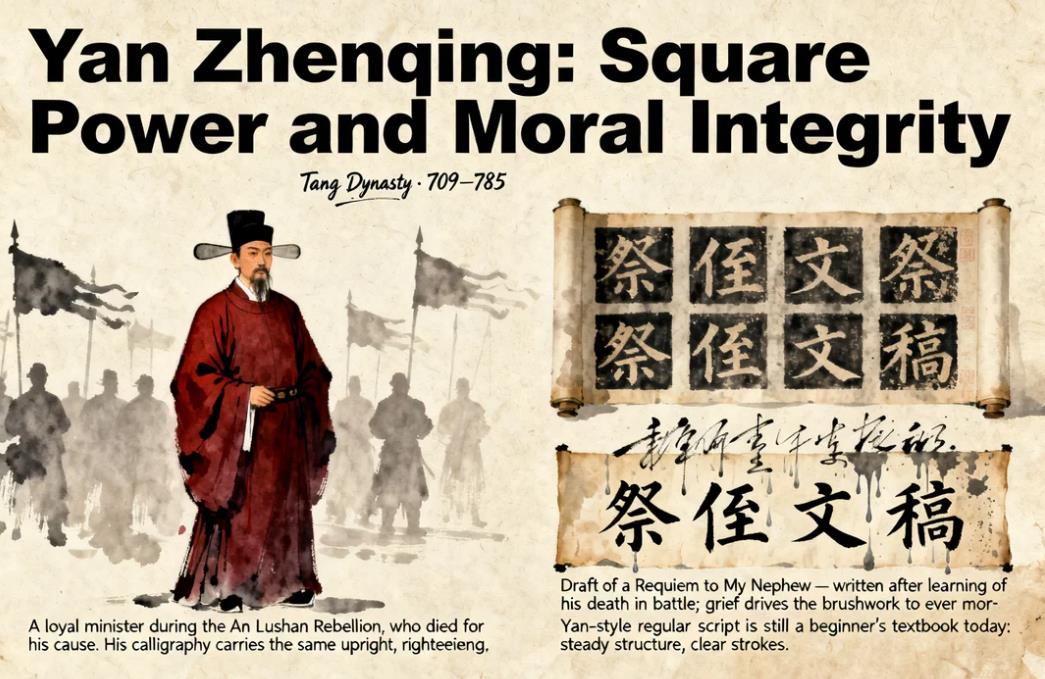
His representative works include the Preface to the Requiem to My Nephew, written in a state of grief after learning of his nephew’s death. The brushwork becomes increasingly emotional as the text progresses, making it one of the most moving pieces in Chinese calligraphy history.
Yan style regular script remains one of the most widely studied models for beginners. Its firm structure and clear strokes make it an excellent foundation for learning brush control.
Huai Su: The Wild Spirit of Cursive Script
Huai Su (737–799) was a Buddhist monk and one of the greatest masters of cursive script. His work is famous for its speed, energy, and almost musical rhythm.
Huai Su is said to have practiced calligraphy so intensely that he wore out many writing brushes. He even planted banana trees because he could not afford enough paper, using their large leaves for practice.
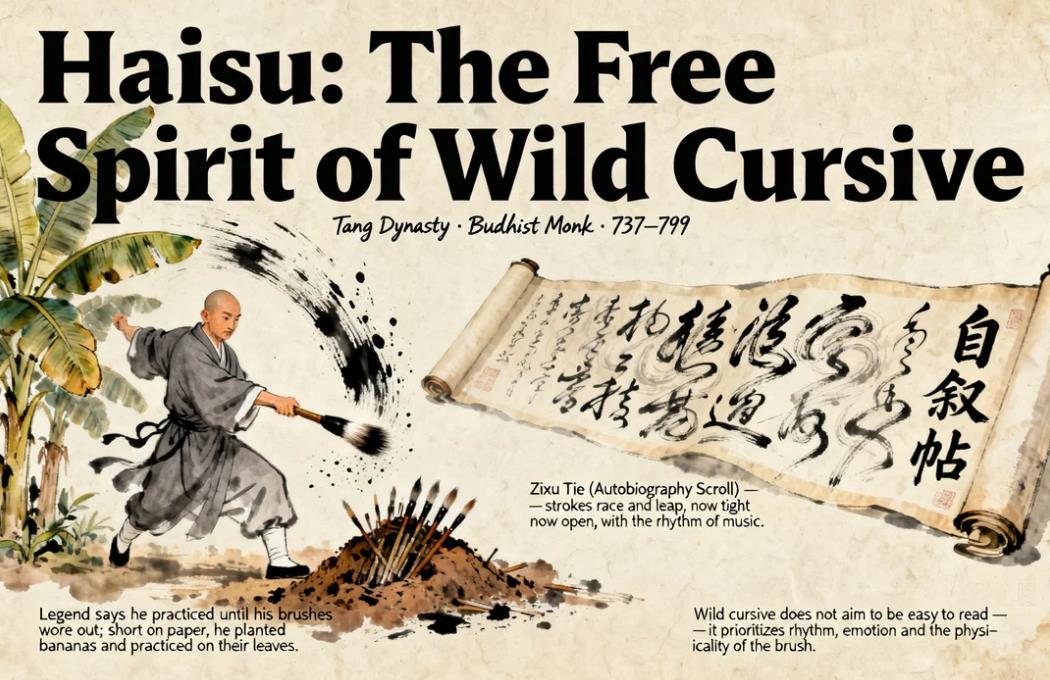
His most celebrated work is the Autobiography of Huai Su, a long cursive scroll that shows his extraordinary command of movement. The characters twist, stretch, and flow across the page with dramatic variation in size and ink tone. Some sections are dense and rapid, while others open into spacious, breath-like pauses.
Huai Su’s cursive script represents one extreme of calligraphic expression. It is less concerned with strict legibility and more focused on rhythm, emotion, and the physical energy of the brush.
Su Shi: The Scholar’s Calligraphy
Su Shi (1037–1101), also known as Su Dongpo, was a poet, essayist, statesman, and calligrapher of the Song dynasty. He is one of China’s most beloved literary figures, and his calligraphy reflects the same warmth and personality found in his writing.
Su Shi believed that calligraphy should express the writer’s true character. He valued naturalness over rigid perfection. His brushwork is often relaxed, slightly heavy, and full of personal charm.
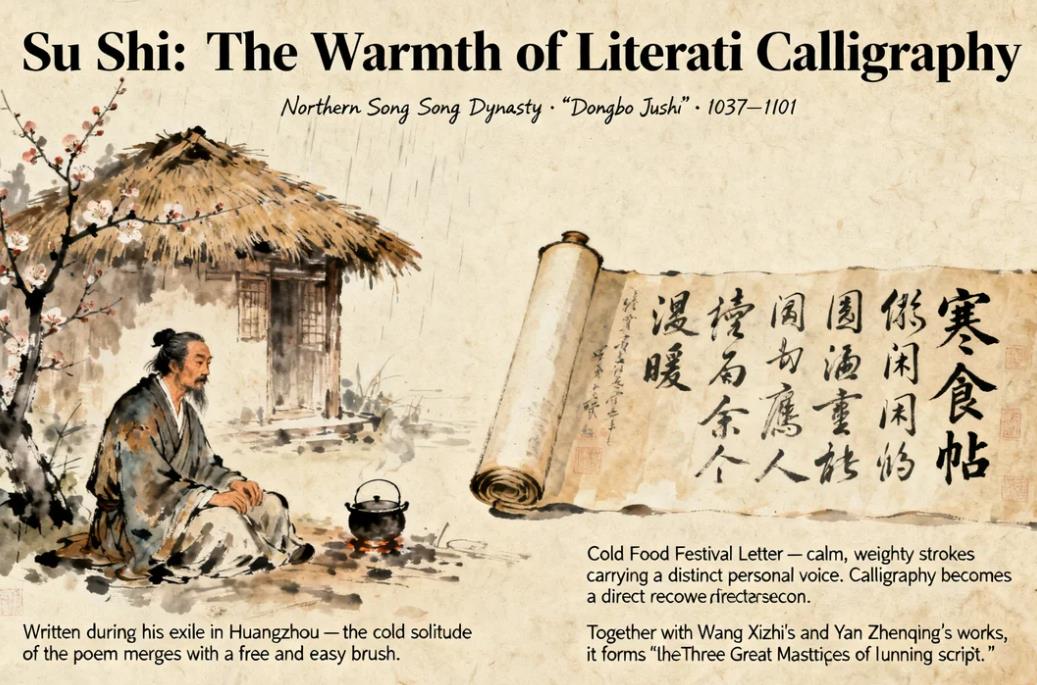
One of his most famous works is the Cold Food Observance, written during a period of exile. The piece combines poetic melancholy with informal brushwork, creating a sense of intimate human presence. It is sometimes called the third greatest running script work in Chinese history, after Wang Xizhi’s Lanting Xu and Yan Zhenqing’s Requiem to My Nephew.
Su Shi’s style shows that calligraphy is not only about technical mastery. It can also be a direct record of mood, experience, and personality.
Huang Tingjian: Expansive Structure and Long Strokes
Huang Tingjian (1045–1105) was a close friend of Su Shi and one of the leading calligraphers of the Song dynasty. He excelled in both running script and cursive script.
His calligraphy is known for its expansive structure and long, stretching strokes. Characters often open outward, creating a sense of spaciousness and confidence. His lines can appear slow and deliberate, yet they carry strong inner tension.
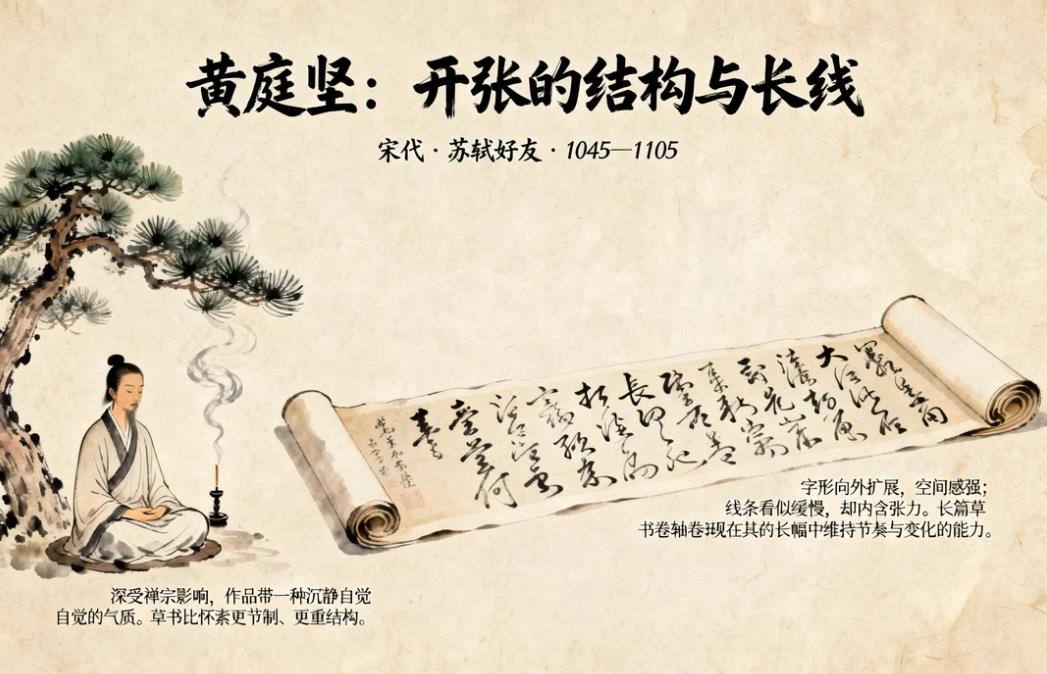
Huang Tingjian was also deeply influenced by Zen Buddhism. His work sometimes feels meditative, as if each stroke is placed with careful awareness rather than haste.
His representative works include long cursive scrolls that demonstrate his ability to sustain rhythm across many characters. Compared with Huai Su’s wild speed, Huang Tingjian’s cursive script feels more measured and architectural.
Zhao Mengfu: Elegance and Classical Revival
Zhao Mengfu (1254–1322) lived during the Yuan dynasty and played an important role in reviving classical calligraphic styles. He studied earlier masters carefully, especially Wang Xizhi, and sought to restore the elegance of Jin and Tang traditions.
Zhao Mengfu was skilled in multiple scripts, including regular, running, and cursive. His brushwork is smooth, refined, and highly controlled. Characters often appear graceful and balanced, with a quiet sense of order.
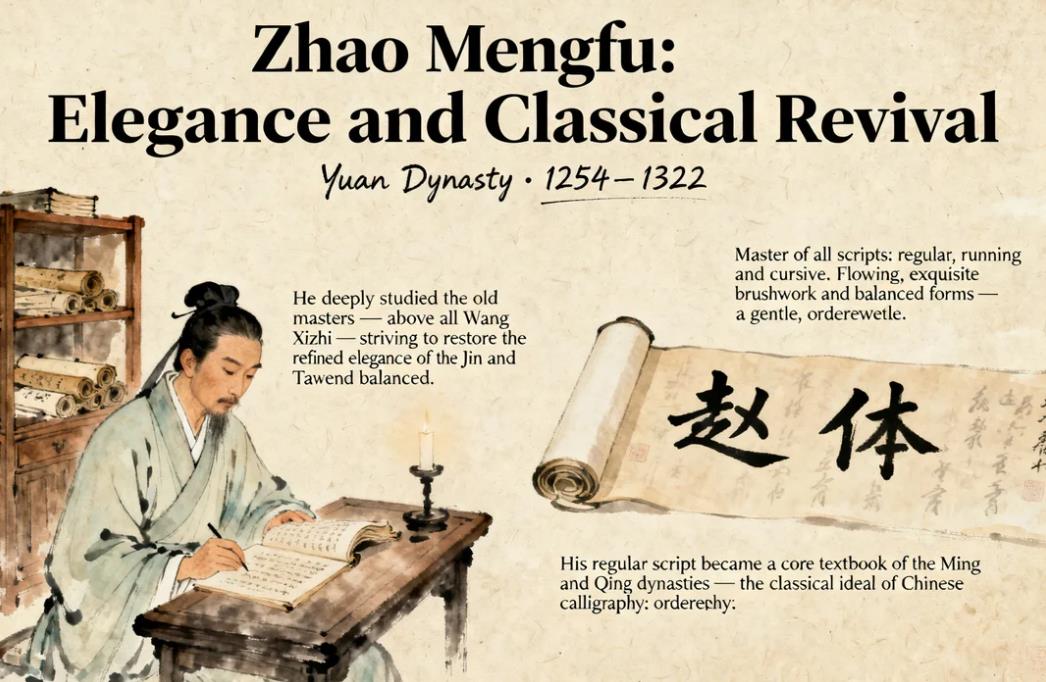
Some later critics questioned his legacy because he served the Mongol-led Yuan court, but his artistic influence remains undeniable. His regular script became one of the most widely copied models in later centuries.
Zhao Mengfu represents the classical ideal in Chinese calligraphy: deep respect for tradition, technical precision, and refined beauty.
How to Compare These Masters
When looking at works by different calligraphers, a few comparisons can help you see their differences more clearly.
Wang Xizhi is celebrated for natural flow and variation. His work feels effortless, yet every stroke is precisely placed.
Yan Zhenqing expresses strength and dignity. His regular script feels solid, upright, and morally grounded.
Huai Su embodies wild freedom. His cursive script moves quickly, with dramatic changes in rhythm and ink.
Su Shi brings personal expression into calligraphy. His work feels human, warm, and closely connected to his life experiences.
Huang Tingjian emphasizes structure and spatial awareness. His characters often stretch outward, creating a sense of openness.
Zhao Mengfu stands for classical elegance. His brushwork is polished, balanced, and deeply rooted in earlier traditions.
Together, these calligraphers show that Chinese calligraphy is not a single style. It is a broad artistic tradition that can be disciplined or wild, classical or personal, calm or intensely emotional.
Frequently Asked Questions
Who is the most famous Chinese calligrapher?
Wang Xizhi is usually considered the most famous. He is traditionally called the Sage of Calligraphy, and his Preface to the Poems Collected from the Orchid Pavilion is one of the most celebrated works in the art form.
Which calligrapher is best for beginners to study?
Yan Zhenqing and Zhao Mengfu are often recommended for beginners because their regular script is clear, structured, and relatively easy to follow.
What is the most famous calligraphy work in China?
Wang Xizhi’s Preface to the Poems Collected from the Orchid Pavilion is widely regarded as the most famous. Yan Zhenqing’s Preface to the Requiem to My Nephew and Su Shi’s Cold Food Observance are also highly celebrated.
What is the difference between Wang Xizhi and Huai Su?
Wang Xizhi is known for refined, natural running script, while Huai Su is known for wild, expressive cursive script. Wang Xizhi emphasizes elegance and variation; Huai Su emphasizes speed, rhythm, and emotional intensity.



There are no comments yet, come and comment~