
If you are new to mahjong, the biggest source of confusion is often this: American mahjong and Chinese mahjong look similar, but they play quite differently. Both come from the same traditional game, yet they have developed their own rules, tiles, scoring systems, and social cultures.
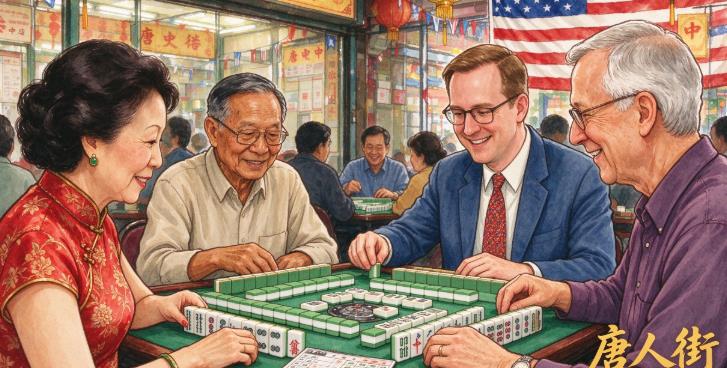
Understanding these differences helps you choose the right version to learn, find the right community, and avoid mixing up rules at the table.
Where do American mahjong and Chinese mahjong come from?
Mahjong originated in China in the late 19th or early 20th century and quickly became a popular social game. It reached the United States in the 1920s and has since evolved into a distinct American style.
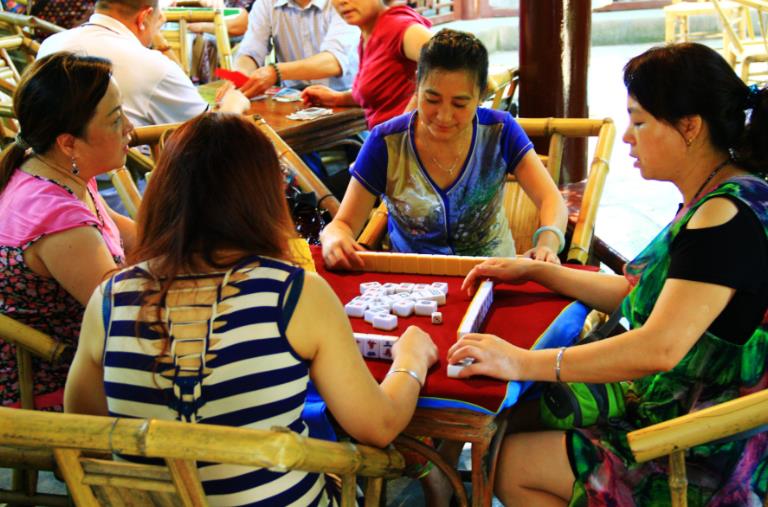
Chinese mahjong remains closely connected to family gatherings, festivals, and local traditions. American mahjong, especially the version played through the National Mah Jongg League, has become a structured club game with annual hand cards and standardized rules.
Tile differences
The most visible difference is the set of tiles.
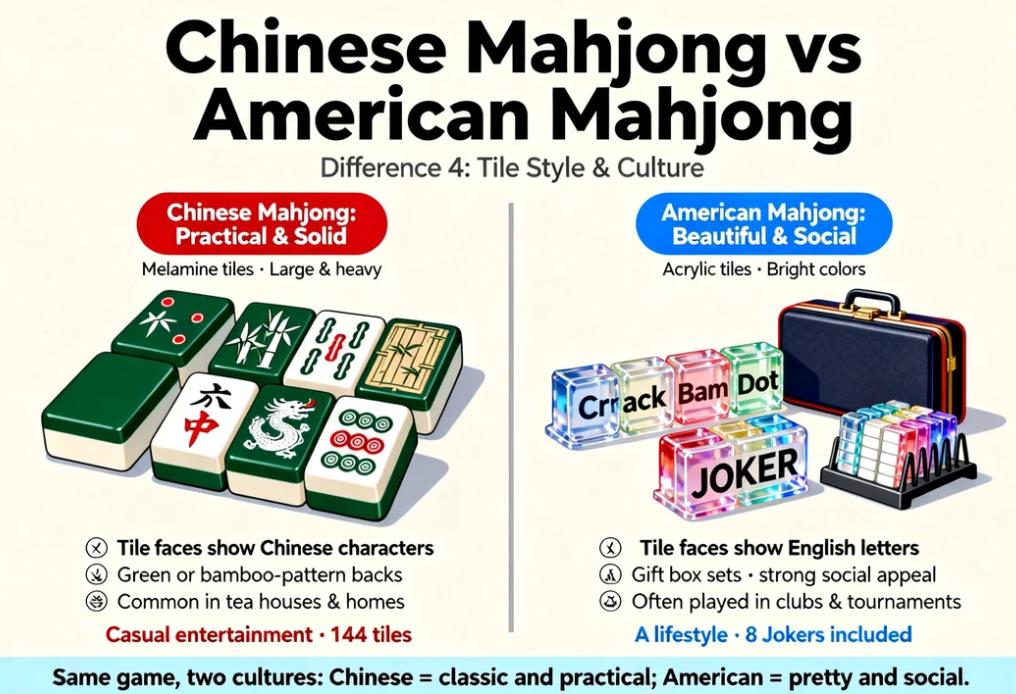
Chinese mahjong usually uses 144 tiles. These include bamboo, characters, circles, winds, dragons, and often flowers and seasons. The exact number can vary by region, but the game generally emphasizes a full traditional set.
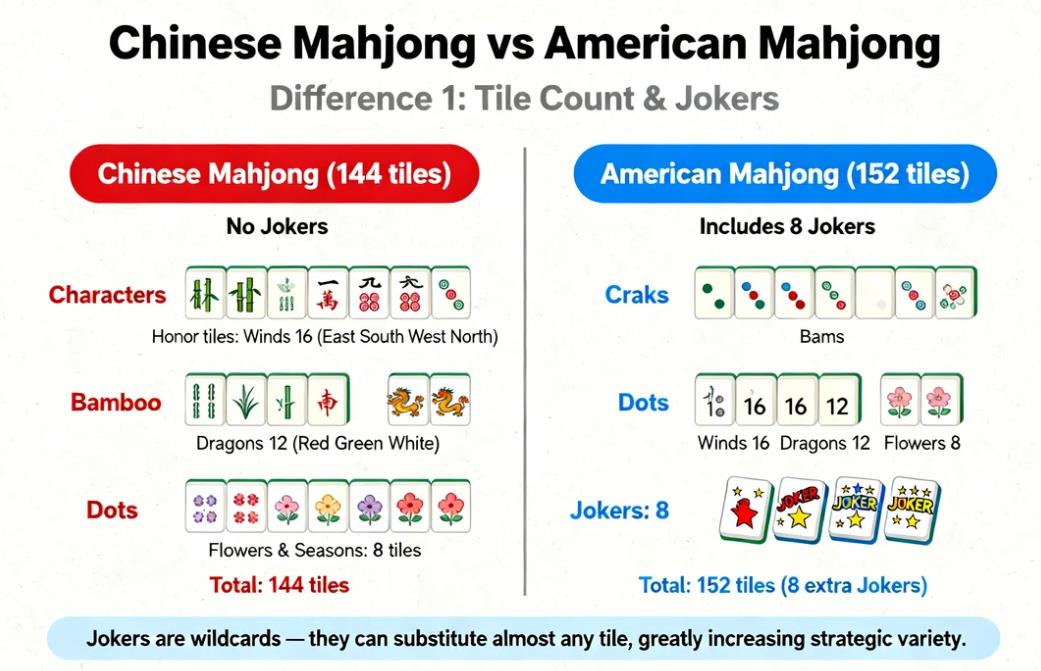
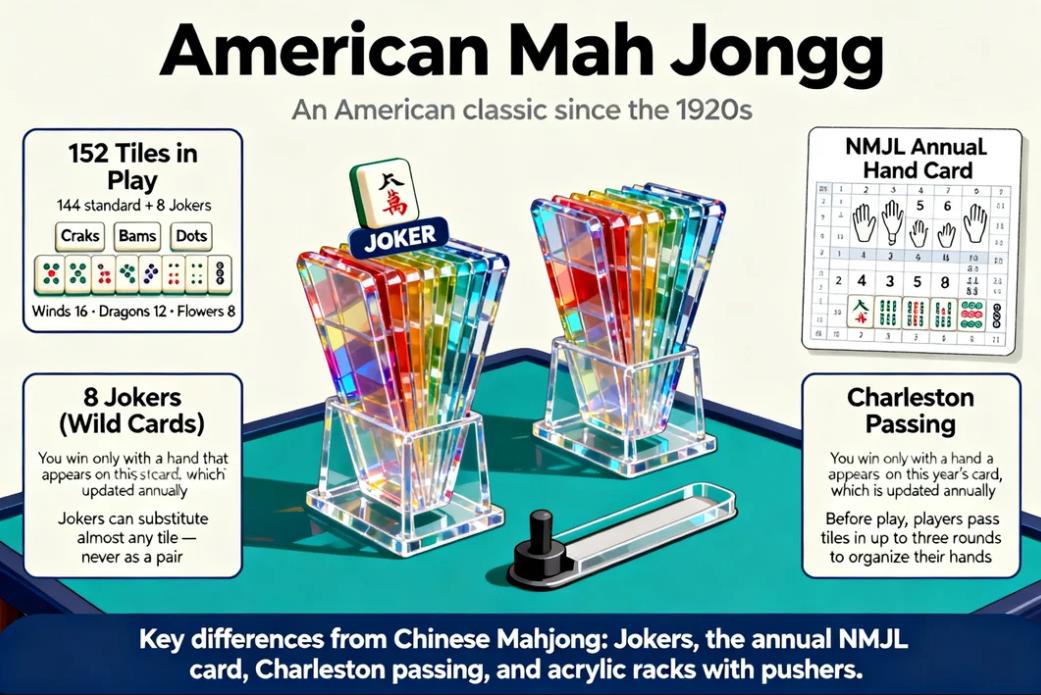
American mahjong typically uses a larger set. It often includes 152 tiles or more because it adds jokers. Jokers are important in American mahjong, as they can substitute for certain tiles when building official hands.
For beginners, American tiles may feel easier to read because many modern sets include numbers or English labels. Traditional Chinese tiles rely more on symbols, which can take longer to learn but carry strong cultural meaning.
Rule differences
Chinese mahjong is flexible. Players form winning hands using sequences, triplets, pairs, and other combinations. Rules vary across regions, so a game played in one Chinese city may differ from another.
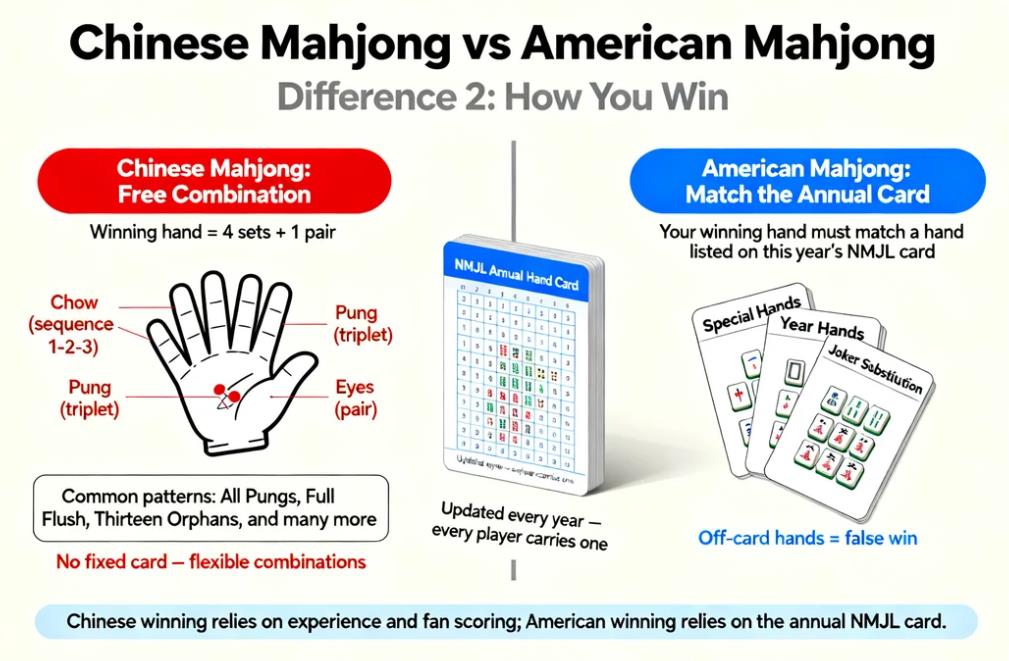
American mahjong is more standardized. Players follow an official hand card published each year by the National Mah Jongg League. The card lists specific winning patterns, and players try to complete one of those hands.
This makes American mahjong feel more like a guided puzzle. Chinese mahjong feels more open-ended, because players adapt their hands based on what they draw and what others discard.
Scoring and gameplay flow
Chinese mahjong scoring can be complex. Points may depend on the type of hand, special tiles, self-drawn wins, and regional variations. Some versions are simple, while others are highly competitive.
American mahjong scoring is usually simpler for club play. If a player completes a hand on the official card, the hand has a fixed point value. This makes it easier for new players to understand whether they have won.
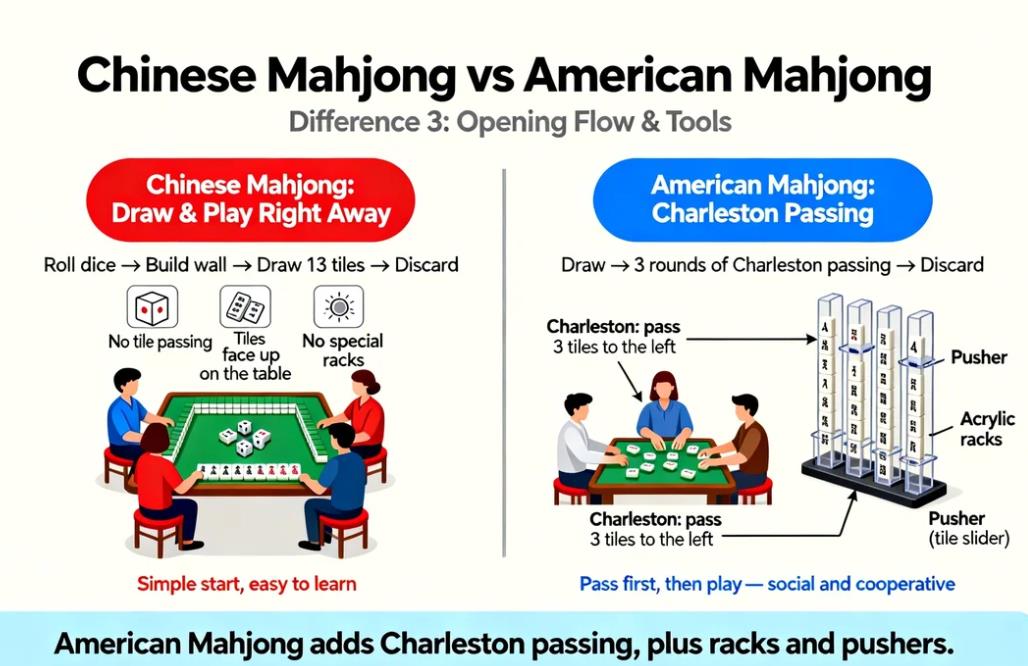
Gameplay flow also differs. In American mahjong, players often call “Mahjong” when completing a hand from the official card. In Chinese mahjong, players may win through different combinations, and the winning condition depends on the agreed rules.
Which version is easier for beginners?
If you want a clear structure, American mahjong may feel easier at first. The annual hand card tells you exactly which patterns count, and club rules help keep the game consistent.
If you want a more flexible, traditional experience, Chinese mahjong may be more appealing. It allows more creativity during play, but you may need to decide which regional rules to follow before starting.
For absolute beginners, the best approach is to learn one version first. Trying to learn both at the same time can be confusing, because the tiles, winning conditions, and calling rules are not interchangeable.
Can you switch between versions later?
Yes. Once you understand the basic idea of drawing, discarding, and completing a hand, moving between versions becomes easier.
Many players start with American mahjong through local clubs, then explore Chinese mahjong out of cultural curiosity. Others begin with Chinese mahjong because they learned it from family, then discover American mahjong through friends or online communities.
The key is to clarify which rules are being used before the game begins.
Frequently asked questions
Is American mahjong the same as Chinese mahjong?
No. They share the same origin, but American mahjong and Chinese mahjong have different tiles, rules, scoring systems, and winning conditions.
Does American mahjong use jokers?
Yes. American mahjong often includes jokers, which can substitute for certain tiles when building official hands.
How many tiles are in a Chinese mahjong set?
A traditional Chinese mahjong set usually has 144 tiles, though the number can vary by region and house rules.
Which mahjong is more popular in the U.S.?
American mahjong has a large organized player base, especially through clubs and the National Mah Jongg League. Chinese mahjong and Japanese riichi mahjong are also growing in popularity.
Can beginners learn mahjong without prior experience?
Yes. Mahjong looks complex at first, but beginners can start with one rule set, learn the basic tiles, and practice with simple winning hands.



There are no comments yet, come and comment~