
When people first hear about karma and rebirth in Chinese Buddhism, they often imagine a fixed system of reward and punishment: what you did in a past life determines your present, and what you do now determines your future. But this is only part of the picture.
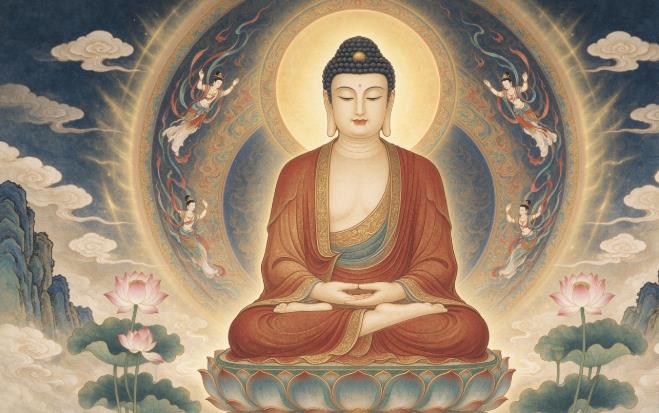
In Chinese Buddhism, karma is closer to a pattern of mental and behavioral momentum. Past actions shape present conditions, and present actions continue shaping the future. Karma is not judged by an external god or cosmic court. It arises naturally from body, speech, and mind.
What is karma?
Karma is not limited to physical actions. Chinese Buddhism commonly divides karma into three types:
- Body karma: actions performed through the body
- Speech karma: the impact of words, such as honesty, harshness, or gossip
- Mind karma: thoughts, intentions, and motivations
Mind karma is especially important. Many actions begin as mental habits. An angry thought may not immediately cause harm, but it can strengthen a tendency toward anger. A compassionate thought can gradually soften the mind.
How does karma work?
Karma can be understood like seeds. Each action leaves an imprint in the deeper layers of consciousness. When conditions come together, these imprints may appear as personality traits, relationships, environments, or life circumstances.
This does not mean everything is fixed. Karma shapes the hand you are dealt, but it does not decide how you play it. If someone habitually reacts with anger, conflict may follow. If the same person begins to practice mindfulness, ethical speech, and kindness, new patterns can develop.
Chinese Buddhism teaches that practice is not about escaping cause and effect. It is about making wiser choices within it.
What does rebirth mean?
Rebirth refers to the continuation of life driven by karma and mental habits. Chinese Buddhism often speaks of the six realms: gods, humans, asuras, animals, hungry ghosts, and hell beings.
These realms are not only understood as places after death. They can also reflect psychological states:
- Being ruled by craving resembles the hungry ghost realm
- Being consumed by anger resembles the hell realm
- Living without awareness resembles the animal realm
- Being driven by jealousy and competition resembles the asura realm
- Being lost in pleasure and forgetting impermanence resembles the god realm
- Being able to reflect, choose, and cultivate goodness resembles the human realm
So rebirth is not only a distant future concern. It is also connected to the habits forming in the mind right now.
How is karma different from fate?
Many people confuse karma with fate. They are not the same:
| Concept | Meaning | Can it change? |
|---|---|---|
| Fate | Often seen as a fixed plan | Usually viewed as unchangeable |
| Cause and effect | Relationship between actions and results | Can be influenced by new choices |
| Karma | Mental and behavioral momentum | Can be transformed through practice |
| Rebirth | Continuation driven by ignorance and attachment | Can be transcended through awakening |
Chinese Buddhism does not encourage passive resignation. Because karma exists, present choices matter.
How can karma be transformed?
Transforming karma does not mean erasing the past. It means changing present patterns. Common methods include:
Ethical conduct
Reducing harm, lying, stealing, sexual misconduct, and intoxication helps protect the mind from regret and confusion. Precepts are not meant as punishment, but as support for clarity.
Meditation
Observing the breath, body sensations, and thoughts helps create space between impulse and reaction. Mindfulness allows a person to notice anger, greed, or fear before acting on them.
Chanting and sutra recitation
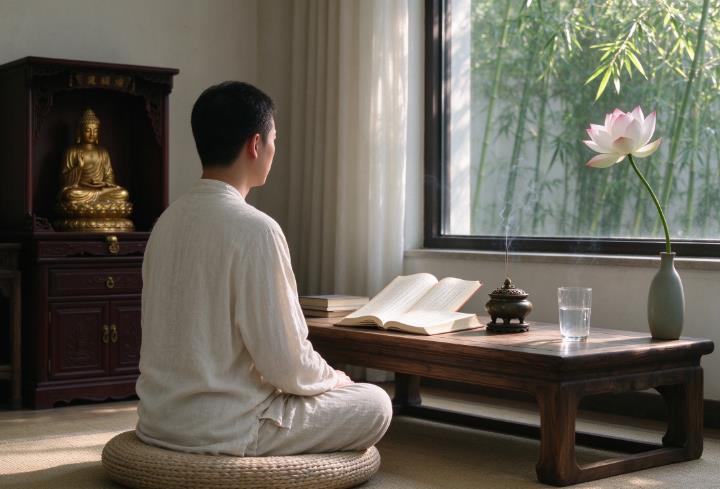
Pure Land Buddha-name chanting and temple chanting help settle a scattered mind. In Chinese Buddhism, chanting is not only ritual; it is also a training in concentration, reverence, and inner harmony.
Good deeds and dedication of merit
Generosity, protecting life, helping others, and sincere apology can weaken unskillful habits. Dedicating merit is not merely “transferring blessings.” It is also a practice of expanding compassion beyond oneself.
Is Pure Land belief contradictory to karma?
No. Pure Land Buddhism teaches that practitioners may aspire to be reborn in Amitabha Buddha’s Pure Land, but this does not deny karma. Chanting itself is a wholesome action that purifies the mind, reduces distraction, and strengthens faith. Chinese Buddhism does not claim that external power completely replaces personal effort. Faith, aspiration, and daily practice work together.
Frequently asked questions
Is karma superstition?
If karma is reduced to “whatever happens must be punishment from past lives,” it can become superstitious. But Buddhist karma is closer to an observation about how actions, intentions, and results relate. It encourages responsibility rather than fear.
Can rebirth be proven?
Rebirth belongs to the Buddhist worldview, and people will hold different views. Even without settling that question, the idea of rebirth can still invite reflection: what habits am I strengthening now, and where might they lead?
Can karma be eliminated?
It is more accurate to say that past imprints do not simply vanish, but they can be transformed through mindfulness, ethical action, and practice. Like a river, past water has already flowed, but the channel can still be redirected.
Should ordinary people fear karma?
Fear is not necessary, but respect is helpful. Karma is not meant to frighten people. It reminds us that thoughts, words, and actions have consequences. That is precisely why practice matters.



There are no comments yet, come and comment~