
Feng shui (风水, pronounced “fung shway”) is an ancient Chinese practice of arranging spaces to create harmony between people and their environment. The term literally means “wind and water,” referring to the invisible natural forces that shape our surroundings. At its core, feng shui is about cultivating qi (气) — the vital life force energy that flows through all things — and designing living and working spaces that support health, relationships, and prosperity.

For beginners, feng shui can seem overwhelming. But you do not need a master’s consultation to start. Understanding a few foundational principles — yin and yang, the five elements, and the bagua map — is enough to begin making meaningful changes in your home today.
The Three Core Principles of Feng Shui
Every feng shui adjustment rests on three theoretical pillars. These are not decorative preferences but energetic frameworks that have guided Chinese architecture and interior design for over 3,000 years.
Yin and Yang Balance
Yin and yang represent complementary opposites: yin is passive, dark, cool, and soft; yang is active, bright, warm, and hard. A well-balanced space maintains dynamic equilibrium between the two. Bedrooms benefit from yin energy — soft lighting, muted colors, and quiet — while kitchens and home offices thrive with yang energy — bright light, bold colors, and activity. A room that is too yin feels stagnant and depressing; one that is too yang feels chaotic and exhausting.

The Five Elements (Wu Xing)
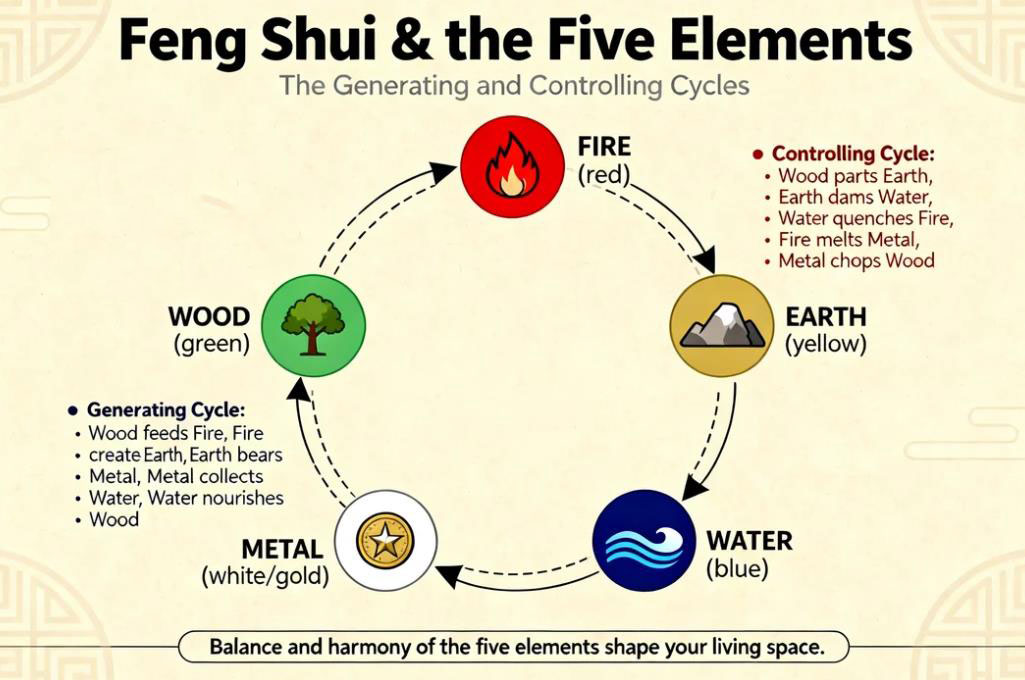
The five elements — Wood, Fire, Earth, Metal, and Water — are not literal materials but symbolic representations of energy phases. Each element corresponds to specific colors, shapes, directions, and qualities:
- Wood (green, rectangular shapes, East/Southeast): growth, vitality, expansion
- Fire (red, triangular shapes, South): passion, visibility, energy
- Earth (yellow/brown, square shapes, Center/Northeast/Southwest): stability, grounding, nourishment
- Metal (white/gray/metallic, circular shapes, West/Northwest): clarity, precision, efficiency
- Water (black/blue, curvy shapes, North): wisdom, flow, flexibility
These elements interact through two cycles. The productive cycle (Wood feeds Fire, Fire creates Earth, Earth bears Metal, Metal collects Water, Water nourishes Wood) generates supportive energy. The destructive cycle (Wood breaks Earth, Earth absorbs Water, Water extinguishes Fire, Fire melts Metal, Metal chops Wood) creates tension and imbalance. Good feng shui uses the productive cycle to enhance desired outcomes and avoids destructive clashes.
The Bagua Map
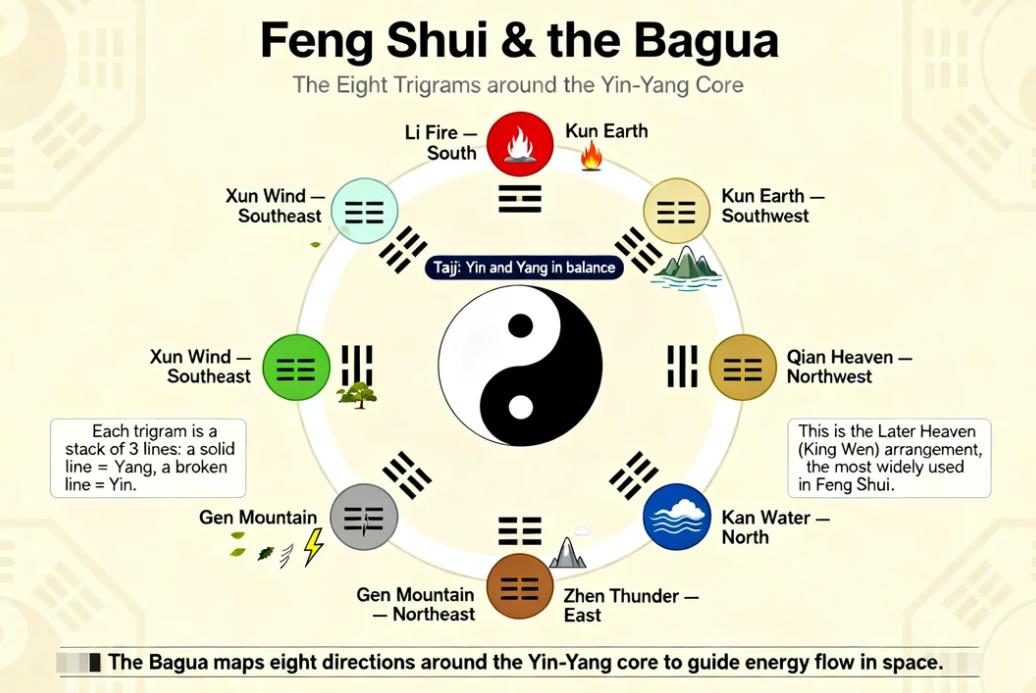
The bagua map is an octagonal grid that overlays your floor plan, dividing a space into nine life areas:
- Wealth & Prosperity (Southeast) — Wood element, green/purple
- Fame & Reputation (South) — Fire element, red/orange
- Love & Relationships (Southwest) — Earth element, pink/red
- Family & Health (East) — Wood element, green/teal
- Center (Center) — Earth element, yellow/brown
- Creativity & Children (West) — Metal element, white/metallic
- Knowledge & Wisdom (Northeast) — Earth element, dark blue/black
- Career & Life Path (North) — Water element, black/dark blue
- Helpful People & Travel (Northwest) — Metal element, gray/white
To use the bagua map, align the bottom edge (Knowledge, Career, Helpful People) with your front door wall, then map each sector onto your floor plan. This tells you which areas of your home correspond to which life goals.
Practical Feng Shui Home Tips for Beginners
You do not need to renovate your entire house to apply feng shui. Start with these high-impact adjustments:
Clear Clutter First
Clutter blocks the flow of qi. Before introducing any cures or enhancements, remove broken items, expired paperwork, and overcrowded surfaces. This is the single most important step in any feng shui practice — energy cannot flow through blocked pathways.
Place Key Furniture in the Command Position
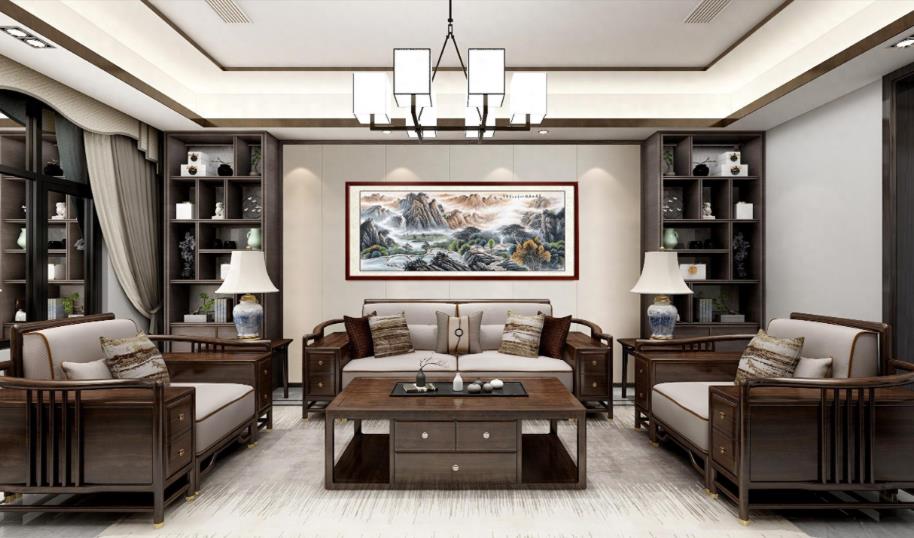
Your bed, desk, and stove should be positioned diagonally opposite the door, with a solid wall behind you and a clear view of the entrance. This “command position” provides psychological security and allows you to see opportunities approaching. Never place your bed directly in line with the door or under a window — this creates vulnerable, unsettled energy.
Fix What Is Broken
Leaky faucets symbolize wealth draining away. Flickering lights represent inconsistent energy. Cracked mirrors can fracture self-image. Addressing maintenance issues is a direct act of feng shui remediation.
Use Natural Light and Air
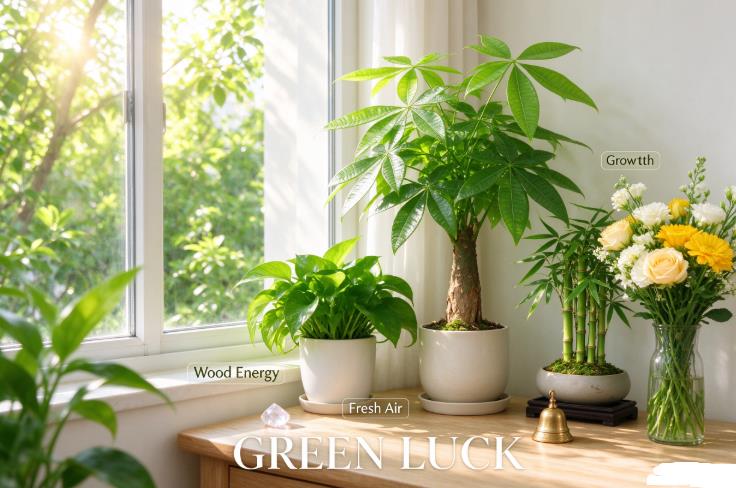
Stale air and darkness suppress qi. Open windows regularly to allow fresh energy to circulate. Use full-spectrum lighting in dim areas. Plants with rounded leaves (avoid spiky cacti in living areas) introduce living wood energy and improve air quality simultaneously.
Common Feng Shui Questions
Is feng shui a religion?
No. Feng shui is a philosophical system and practical methodology rooted in Taoist cosmology, but it can be practiced by people of any faith or belief system. Many people approach it purely from a design and environmental psychology perspective.
Does feng shui really work?
While the concept of qi cannot be measured scientifically, many feng shui principles align with modern environmental psychology — clean spaces reduce stress, good lighting improves mood, and ergonomic furniture placement enhances productivity. Whether you view it as energy work or practical design, the results are often tangible.
How long does it take to see results?
Some people notice immediate improvements in mood and energy within days. For more significant life changes like career advancement or relationship improvements, it typically takes 3–6 months of consistent practice.
Can I have a mirror in my bedroom?
Mirrors facing the bed are generally discouraged in feng shui because they are believed to disrupt sleep by reflecting active energy back at the sleeper. If your mirror faces the bed, try covering it at night or repositioning it.



There are no comments yet, come and comment~