
If you have ever opened a feng shui guide and been confronted with diagrams of five elements, eight directions, and overlapping grids, you probably asked yourself: how does any of this actually work in a real home? The answer is simpler than it looks. Feng shui five elements (Wu Xing) and the bagua map are not separate systems — they are two sides of the same coin. The five elements describe the quality of energy, while the bagua map tells you where that energy lives in your space.
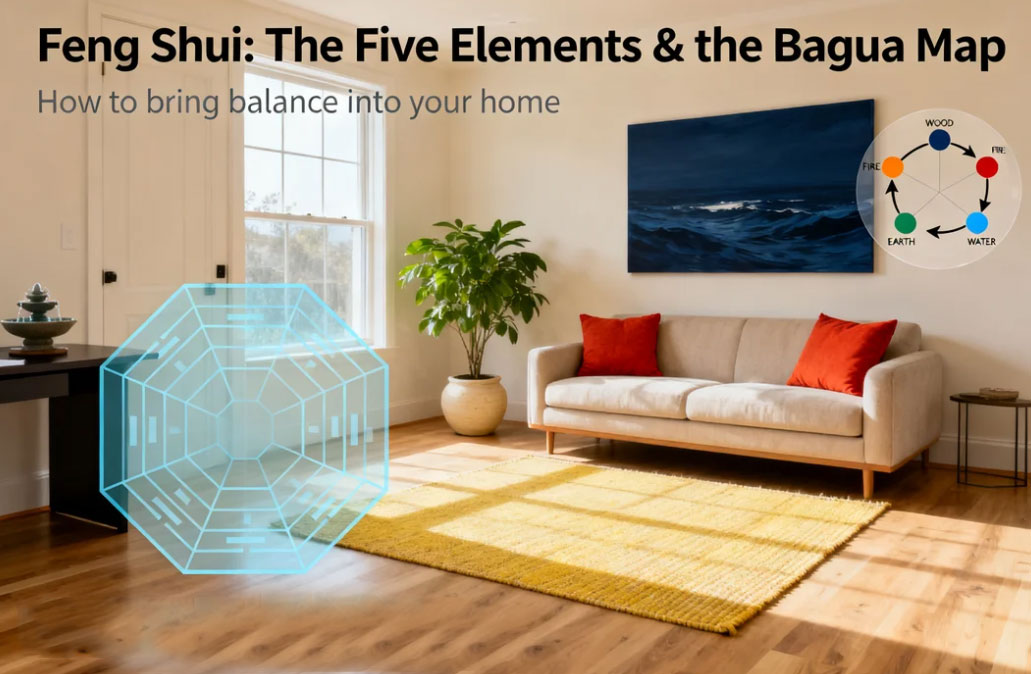
This article goes deeper than surface-level tips. You will learn exactly how each element works, how they interact through productive and destructive cycles, and how to overlay the bagua map onto your actual floor plan to make targeted adjustments.
The Five Elements (Wu Xing) Explained
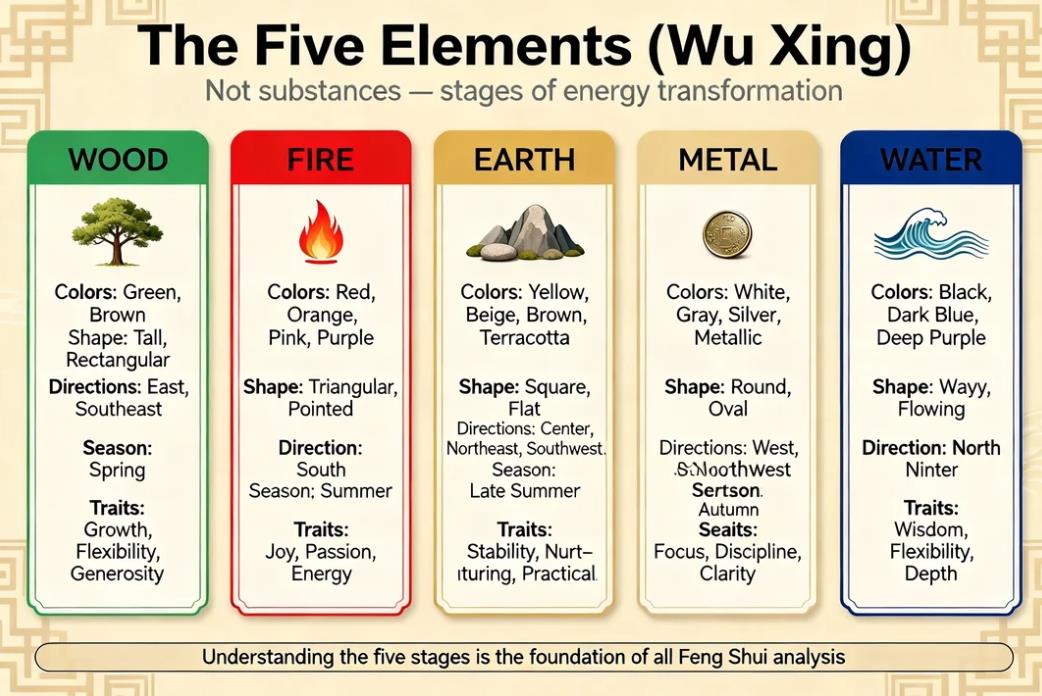
The Chinese term Wu Xing (五行) is usually translated as “Five Elements,” but “phases” or “stages” might be more accurate. Each element represents a stage of energy transformation, not a physical substance. Understanding these five phases is the foundation of all feng shui analysis, from room color choices to annual flying star calculations.
Wood Element
Wood represents growth, expansion, and vitality. In the natural world, it corresponds to spring — the season of new shoots and unfolding leaves.
- Colors: Green, brown
- Shapes: Rectangular, tall and narrow
- Direction: East (health and family), Southeast (wealth and prosperity)
- Season: Spring
- Qualities: Growth, flexibility, generosity, ambition
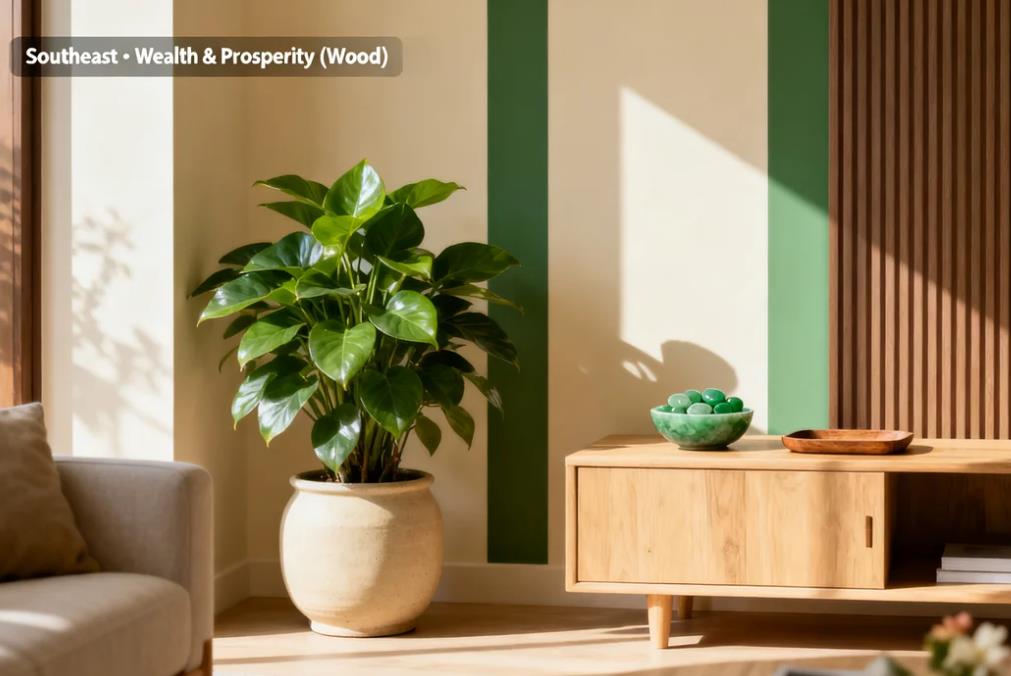
- Feng shui application: Use wood elements in rooms where you want to stimulate growth — a home office for career expansion, or the southeast corner for wealth energy. Tall plants, wooden furniture, and vertical lines all carry wood energy.
People with strong wood energy in their birth chart are typically visionary and compassionate but can become impatient or overly idealistic if the element is unbalanced.
Fire Element
Fire represents visibility, passion, and transformation. It is the most yang of all elements — bright, active, and impossible to ignore.
- Colors: Red, orange, pink, strong purple
- Shapes: Triangular, pointed
- Direction: South (fame and reputation)
- Season: Summer
- Qualities: Joy, enthusiasm, charisma, dynamism
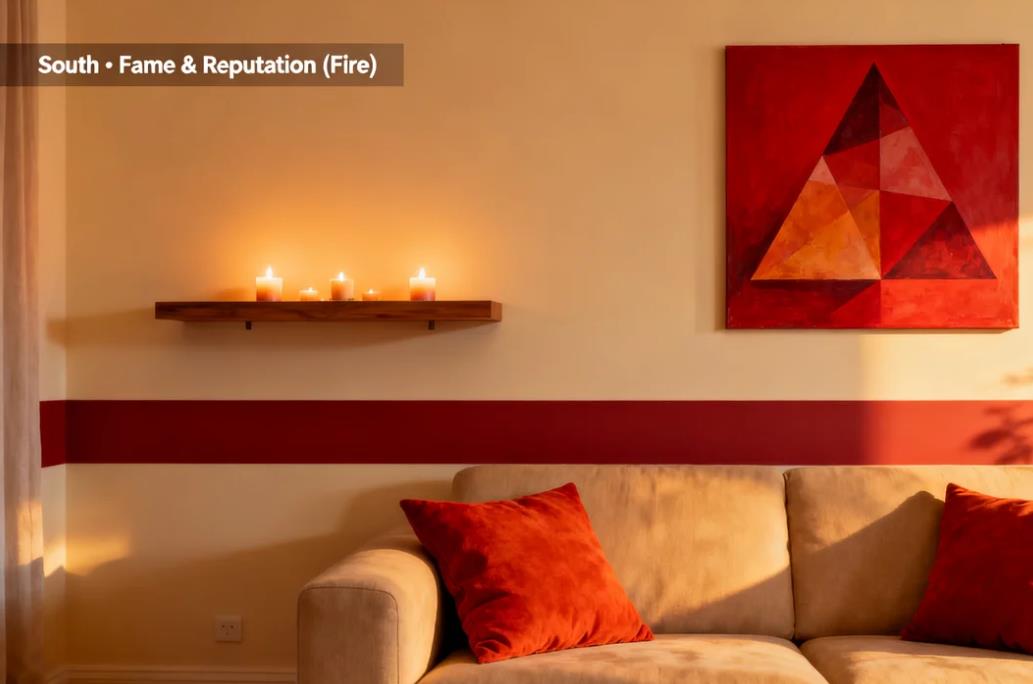
- Feng shui application: Fire energy works well in social spaces like living rooms and dining areas. A small candle, red accent pillow, or triangular artwork can introduce fire. However, too much fire in a bedroom creates restlessness — balance it with yin elements like soft fabrics and cool tones.
Earth Element
Earth represents stability, nourishment, and grounding. It is the centering force that holds everything together.
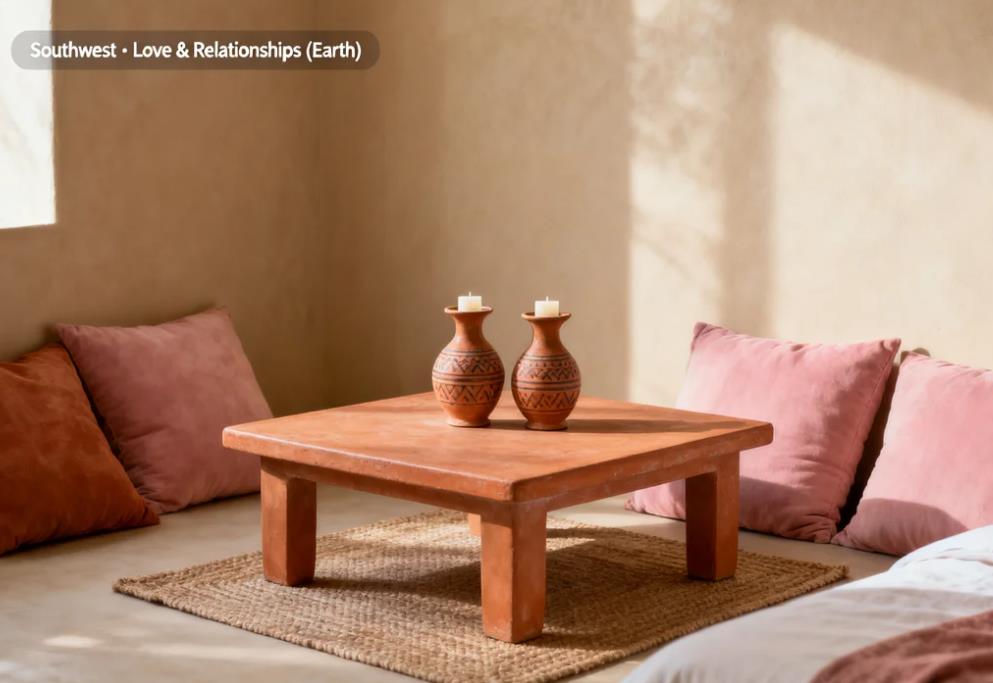
- Colors: Yellow, beige, brown, terracotta
- Shapes: Square, flat, broad
- Directions: Center, Northeast (knowledge and spirituality), Southwest (love and relationships)
- Season: Late summer (the transitional period between seasons)
- Qualities: Patience, reliability, nurturing, practicality
- Feng shui application: Earth elements are 内部技能lent in bedrooms and meditation spaces where calm is desired. Ceramic pots, stone sculptures, and square cushions all carry earth energy. In the kitchen, earth tones can soften the fire energy of the stove.
Metal Element
Metal represents clarity, precision, and efficiency. It is the element of refinement and structure.
- Colors: White, gray, silver, metallic tones
- Shapes: Circular, oval, domed
- Directions: West (creativity and children), Northwest (helpful people and travel)
- Season: Autumn
- Qualities: Focus, discipline, organization, cleanliness
- Feng shui application: Metal works beautifully in home offices and study areas where concentration is needed. Metal frames, wind chimes, and round mirrors introduce metal energy. In bathrooms, where water naturally drains away, adding metal elements helps conserve energy that might otherwise “flow out.”
Water Element
Water represents wisdom, flow, and flexibility. It is the most yin element — receptive, deep, and adaptive.
- Colors: Black, dark blue, deep purple
- Shapes: Wavy, irregular, fluid
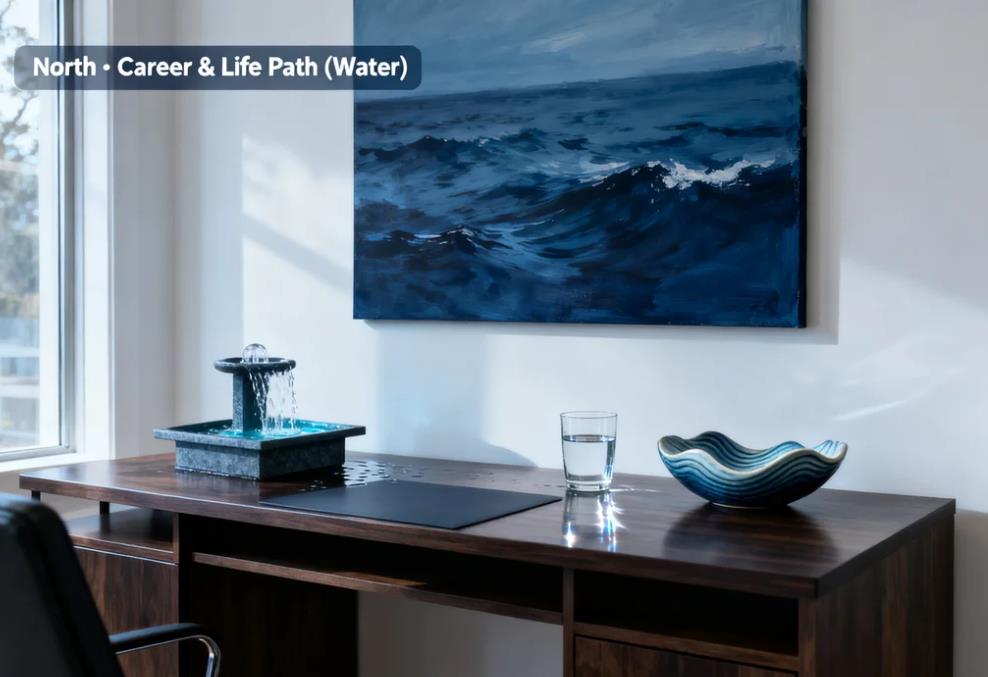
- Direction: North (career and life path)
- Season: Winter
- Qualities: Wisdom, introspection, adaptability, depth
- Feng shui application: Water elements are powerful in the north sector of your home for career support. Small fountains, dark blue artwork, or even a glass of water on your desk can activate water energy. However, too much water in a bedroom may create emotional heaviness — use sparingly and balance with earth or metal.
The Productive Cycle (How Elements Strengthen Each Other)
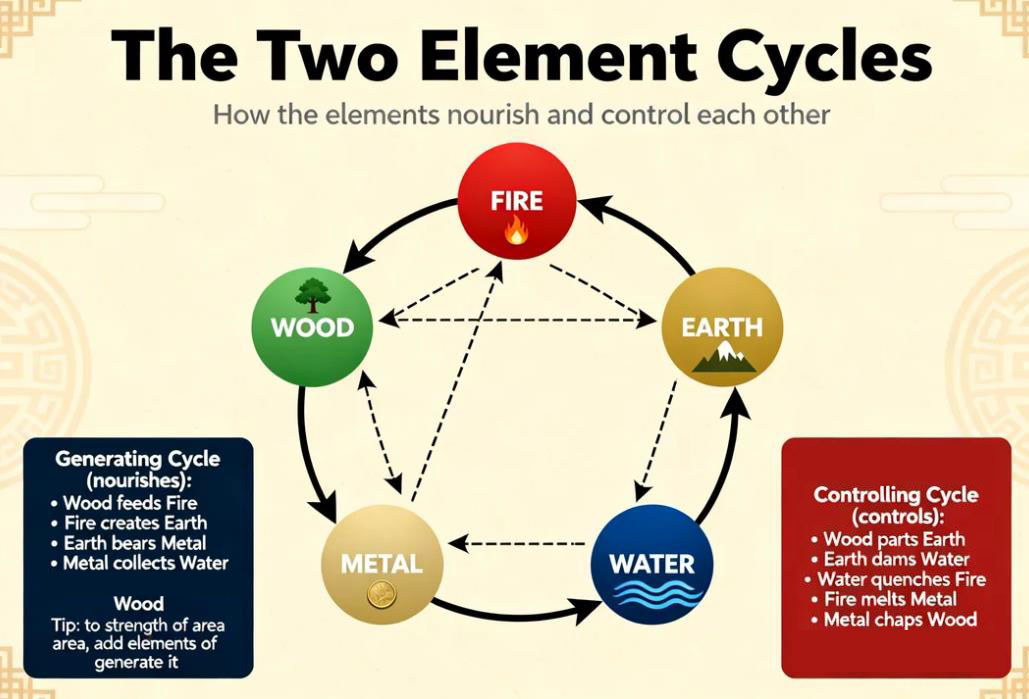
The productive cycle describes how each element nourishes the next in an endless loop of creation:
Wood feeds Fire → Fire creates Earth (ash) → Earth bears Metal (minerals) → Metal collects Water (condensation) → Water nourishes Wood
To strengthen a specific area of your home, you can introduce the element that produces it. For example, if you want to boost fire energy (fame/reputation in the south), place wood elements nearby because wood feeds fire. This is called the “mother produces child” relationship.
The Destructive Cycle (How Elements Weaken Each Other)
The destructive cycle shows how elements can disrupt or control one another:
Wood parts Earth → Earth absorbs Water → Water extinguishes Fire → Fire melts Metal → Metal chops Wood
Understanding the destructive cycle helps you identify energy conflicts in your space. If your home feels tense or arguments are frequent, check whether opposing elements are placed too close together — for instance, a kitchen (fire) directly adjacent to a bathroom (water) may create a water-vs-fire clash that needs balancing.
The Bagua Map Decoded
Now that you understand the five elements, let us look at how they map onto your living space through the bagua. The bagua (八卦) is an octagonal energy grid that overlays your floor plan. Developed by Chinese metaphysicians over a thousand years ago, it connects specific areas of your home to specific life themes.
How to Overlay the Bagua Map on Your Home
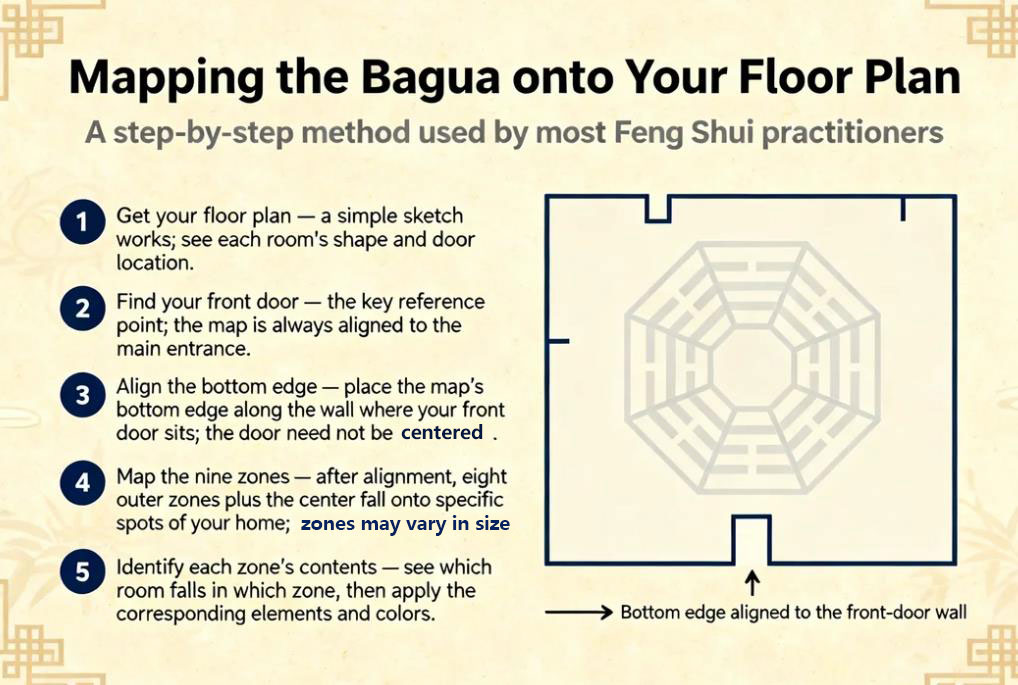
Here is the step-by-step method most practitioners use:
- Get your floor plan. A simple sketch works. You need to see the shape of each room and where the doors are located.
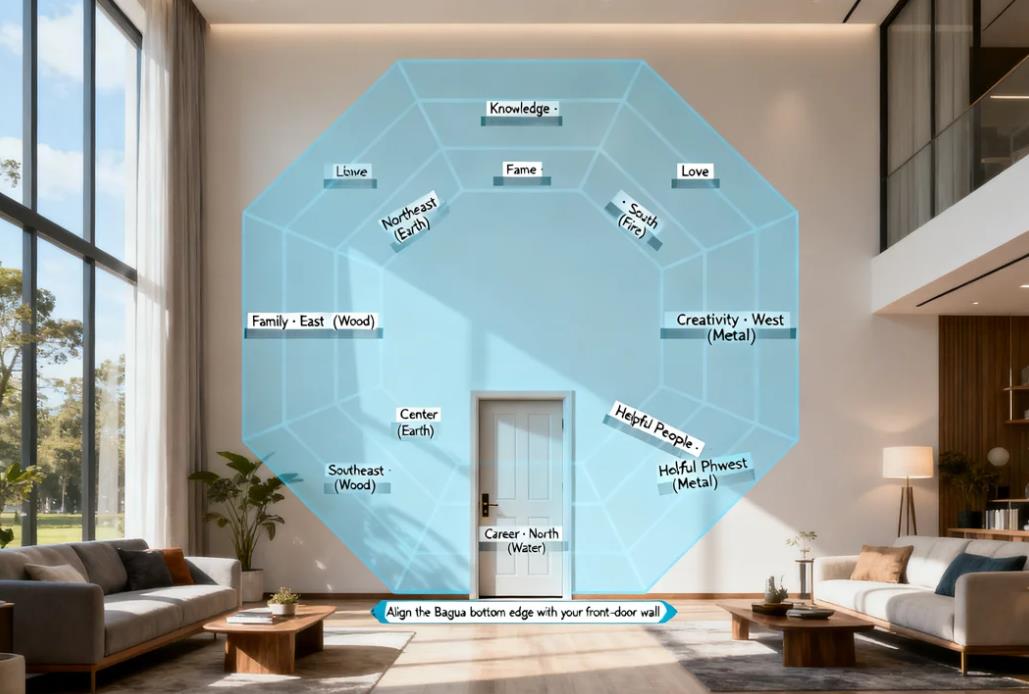
- Find your front door. This is the key reference point. The bagua map always aligns relative to your main entrance.
- Align the bottom edge. Place the bottom edge of the bagua octagon along the wall where your front door is located. The door does not need to be in the center of that wall — just align the bottom edge with that wall plane.
- Map the nine sectors. Once aligned, each of the eight outer sectors plus the center sector will fall on specific areas of your home. The sectors may not divide your space into equal parts — some areas may be larger or smaller depending on your home’s layout. This is normal and correct.
- Identify what lives in each sector. Look at which room or corner falls into each bagua area, then apply the corresponding element and colors to enhance that life theme.
The Nine Bagua Sectors in Detail
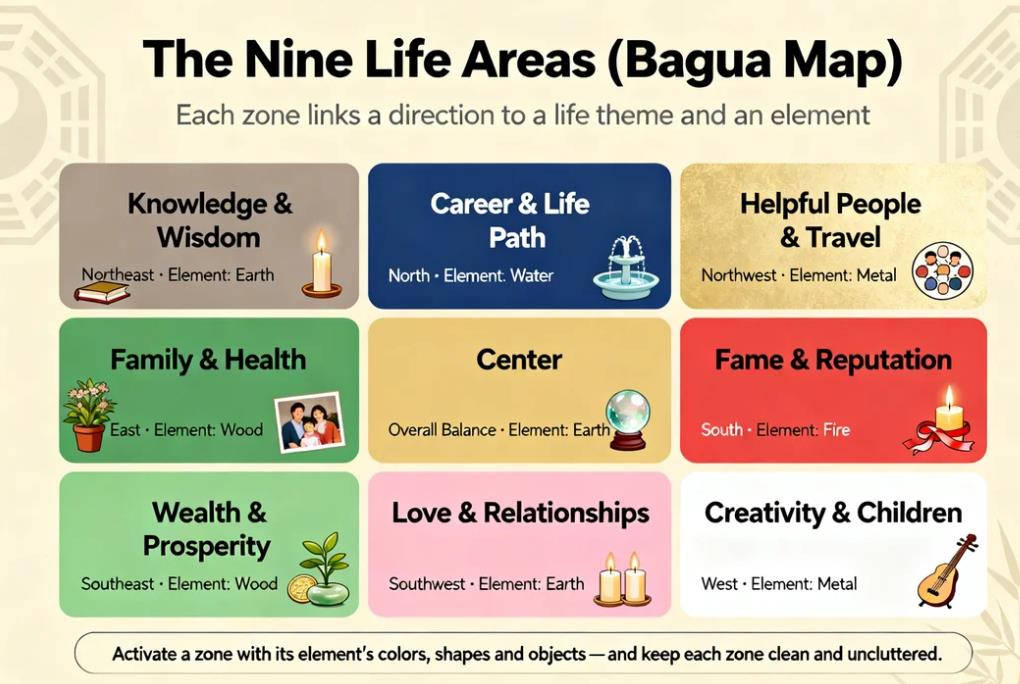
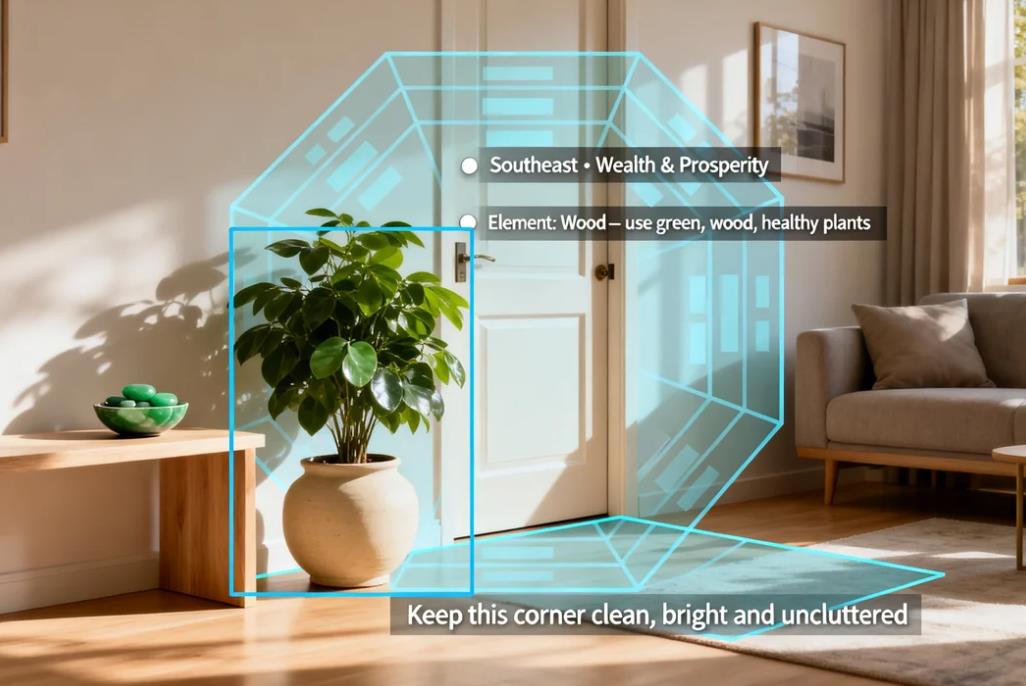
1. Wealth & Prosperity (Southeast) — Wood Element
This sector governs your relationship with money, abundance, and personal value. To activate it: use green or purple colors, healthy plants (avoid artificial flowers), and wooden objects. Keep this area clean, well-lit, and clutter-free. A four-leaf clover or jade stone are popular enhancements.
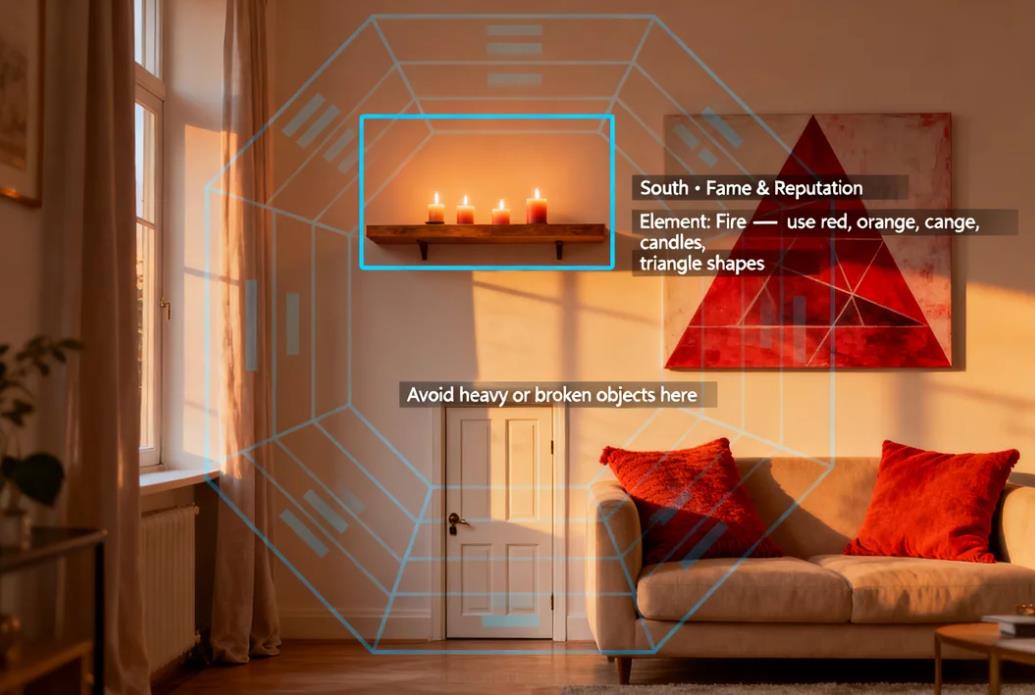
2. Fame & Reputation (South) — Fire Element
This sector relates to your public image, career recognition, and social standing. Activate it with red or orange accents, candles, or triangular-shaped decor. Avoid placing heavy storage or broken items here, as they can suppress your visibility and reputation.
3. Love & Relationships (Southwest) — Earth Element
This sector governs romantic partnerships and deep interpersonal connections. To strengthen it: use pink or earth tones, pair of decorative objects (couples figurines, paired candles), and ensure the space feels balanced and inviting. Single items or sharp objects can create relationship tension.
4. Family & Health (East) — Wood Element
This sector connects to your physical health, family bonds, and personal roots. Activate it with green colors, healthy plants, and family photographs. The east sector benefits from the growth energy of wood — a thriving plant here is considered highly auspicious for family harmony.
5. Center — Earth Element
The center of your home represents your overall well-being and life balance. Keep this area (often a hallway or open space) clean, bright, and peaceful. A yellow or beige rug, a crystal sphere, or a simple bowl of stones can anchor the center’s stabilizing energy.
6. Creativity & Children (West) — Metal Element
This sector governs creative projects, children, and pleasure. Activate it with white, gray, or metallic decor, round shapes, and items that inspire joy. Music instruments, art supplies, or children’s artwork displayed with pride all feed this sector.
7. Knowledge & Wisdom (Northeast) — Earth Element
This sector relates to spiritual growth, self-study, and mentorship. Activate it with dark blue or black accents, books, candles, and objects of spiritual significance. A small meditation corner or study nook in this area supports continuous learning.
8. Career & Life Path (North) — Water Element
This sector governs your career trajectory, life mission, and movement through the world. Activate it with black or dark blue colors, water features (a small tabletop fountain works), and images of flowing water like rivers or oceans. Keep this area moving — avoid stagnation or clutter.
9. Helpful People & Travel (Northwest) — Metal Element
This sector connects to mentors, benefactors, and opportunities that come from outside yourself. Activate it with white, gray, or metallic objects, round shapes, and photos of friends or travel destinations. Keeping this area open and welcoming invites helpful people into your life.
Putting It All Together: A Practical Example
Let us say you want to improve your career. Here is how you would apply both systems together:
- Check the north sector of your home using the bagua map.
- Identify what is currently there — is it a bathroom (water draining away)? A cluttered closet? An empty dark corner?
- Apply the water element to strengthen career energy: add a small fountain, dark blue artwork, or a mirror (mirrors also expand space).
- Remove blockers: clean clutter, fix leaky faucets, ensure good lighting.
- Set an intention: as you make these changes, mentally state what you want your career to look like. Feng shui works best when physical adjustments are paired with clear intention.
This same process applies to any life area — just swap the direction, element, and colors accordingly.
Common Mistakes When Using the Bagua Map
Mistake 1: Using the wrong bagua method. There are multiple bagua systems (Classical, Black Hat, Western Doors). For most home practitioners, the traditional method of aligning the bottom edge with the front door wall is the most widely accepted. Stick with one system and do not mix methods.
Mistake 2: Overdoing one element. Adding a red lamp for fame is fine. Painting every wall red because you want more recognition will create fire overload — agitation, sleep issues, and arguments. Less is almost always more in feng shui.
Mistake 3: Ignoring the command position. No amount of bagua tweaking will help if your bed or desk is in a vulnerable position. Always fix the command position first, then apply bagua enhancements.
Mistake 4: Forgetting about the center. The center of your home is the heart of your feng shui chart. If it is cluttered, dark, or used as a storage room, it can undermine all other sector adjustments. Keep it open and energized.
Frequently Asked Questions
Can I use the bagua map if I rent and cannot change the layout?
Yes. Feng shui works with what you can control — colors, objects, lighting, and clutter management. You do not need to renovate to apply feng shui effectively.
Do I need to use all five elements in my home?
Ideally, yes — balance is the goal. But start with the sectors you feel need the most support. You do not need to force an element into a room where it feels completely wrong.
What if my home does not have a perfect square shape?
Most homes are not perfect rectangles. That is fine. The bagua map still applies — some sectors may simply be smaller or partially missing. Focus on what you can work with rather than worrying about architectural imperfections.
How often should I update my feng shui adjustments?
Seasonal changes are a good natural rhythm. Many practitioners refresh their bagua enhancements at the start of each season or during spring cleaning. Annual flying star practitioners update their layout every January.


There are no comments yet, come and comment~